

Over the course of researching gaming literature and theory, I discovered the work of Richard Duke, a professor and designer of games intended to improve professional practice and policy discussions in a world that he saw as increasingly antagonistic toward individual agency and effective decision-making.
I’ve invoked Duke before in multiple articles and essays. At the end of 2024, I gave the man his due and posted a three-part series that overviewed his life and work and his theory of gaming, and I analyzed some indie RPGs that illustrate his ideas.
Those posts were published in anticipation of a then-upcoming catastrophe point in US politics. I, like Duke, hope gaming can help us work through adversity and find the path toward, to quote John Cale, “a stronger, loving world to die in.”
I wasn’t alone. Two months later, in the first week of January 2025, two publications were released within a day of one another: Leopards Eat Your Face and Survive the Tyrant! Both share with Duke and me the conviction that somehow, someday, gaming will change the world for the better. How each of these titles sees games achieving this goal, though, is a fascinating contrast and an interesting coda for my October 2024 posts.
Leopards Eat Your Face
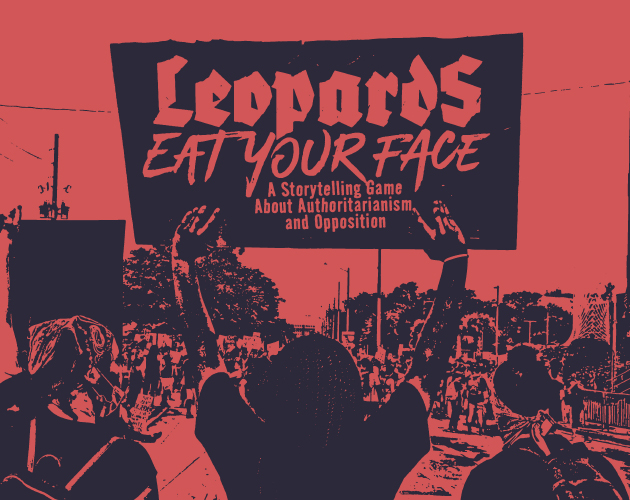
Lucas Falk, Bläckfisk Publishing
Disclosure: I worked with Lucas editing Heroes of Cerulea and will be doing the same with Knight Forlorn. I’m not attached to Leopards Eat Your Face in any way, and I won’t receive any remuneration for writing about it here. I just think it’s worth talking about and promoting on its own merits.
This is a game about oppression and opposition. It is thoughtful and heavy, but it’s not without its own humorous edge—a razor-sharp one at that. “I wrote this game in anger and frankly, I’m not even sure it works yet,” Falk writes. “But I’m betting you’re used to navigating broken systems. Let me know if it can be fixed.”
The comment is manifestly about the game mechanics themselves, but indirectly, it’s speaking on the real-world dynamic those mechanics model. Can you fix a political system that is willfully broken as hell?
Leopards Eat Your Face is based on Dog Eat Dog, which I’ve written about before in a similar context, a game about the equally broken politics of imperialism and colonialism. It is an excellent, landmark game in its own right, and Leopards adapts it to the emerging political climate (though in no way overwrites it, as the problems Dog Eat Dog explores are very much related and still present).
In gameplay, all but one of the players start as radicals who are pushing back against reactionary, regressive changes to the game’s constitutional laws (which start as freedom of expression, universal suffrage, right to privacy, and freedom of assembly). The other player, who will work to subvert and suppress those laws, is the patriot.
By the strict dictionary definition, this may seem like an unusual use of the term patriot, but in the reality of the current climate—and historically as well—it’s extremely appropriate. I’d explain in my own words, but I don’t think I can top what William Poundstone wrote in his excellent book about game theory, Prisoner’s Dilemma:
…in another of the Air Force studies [conducted during the Cold War] at Ohio State, Daniel R. Lutzker found a strong correlation between “internationalism” and cooperation. He created a psychological test that measured views on international cooperation. (One of the items held to measure cooperation was, “We should have a World Government with the power to make laws which would be binding to all its member-nations.”) Then he ran the standard test [a competitive zero-sum game]. Lutzker’s group of “isolationists” pushed the red button [indicating defection, noncooperation] more than his “internationalists.” Lutzker concluded bluntly that “‘Patriotism’ and ‘nationalism’ appear to be related to a lack of trust in others and an incapacity to strive for mutual benefit even under conditions where cooperation leads to greater personal gain”—strong words, considering that Lutzker was a lieutenant in the psychology service at Fort Dix.
In short, Lutzker found that people who identify as nationalists—patriots—tend to willfully work against their own interests as long as their efforts are detrimental to the “other side.” Their self-harm is preferable to cooperation that would mutually benefit both parties. The patriot’s priority is to maximize harm to their perceived enemy.
That’s exactly what they’ll do in Leopards Eat Your Face: erode the constitutional laws to “own the libs” (not Lucas’s words) with all that entails.
Gameplay is strongly weighted in favor of the patriot. To resolve conflicts, the radicals each get one die, and the patriot gets one die for each radical; whoever rolls higher gets to narrate the outcome. Radicals operate on consensus—they must all agree on outcomes and evaluations. The patriot gets to make decisions unilaterally. A player can overturn a scene resolution by erasing their radical’s core belief or their occupation. When both are gone, the player becomes another patriot.
Character agency and longevity are measured by matches. The first side to run out of matches loses. Everyone has opportunities to gain matches, but whereas the patriot simply accrues them, radicals must spend them to overturn scene outcomes and dispute new laws, and they can only do this twice before becoming a patriot. When that happens, any accrued matches now belong to the patriots.
Using matches for tokens is a marvelous bit of material rhetoric. They represent something that is short lived but dangerous, particularly to the person who wields it. In their uphill battle, the radicals are willing to burn themselves for the greater good, whereas the patriot is willing to burn the whole damned thing down just to be king of a hill that doesn’t exist anymore.
Sound familiar? Yeah.
Survive the Tyrant!
Anonymous
This isn’t actually a game. It’s a gamification of real life under a modern authoritarian regime. You don’t earn points and slay the BBEG to save the world in a climactic heroic battle. You build mutual aid and support networks so that you can survive and then rebuild after a million, million small acts of resistance finally topple the oppressive edifice.
This zine is explicitly written for people with no experience in organized resistance. Instead, it provides strategies and tactics for living under worsening conditions and coming out on the other side to tell a cautionary tale to future generations. The entire method is built on exactly those foundations, which it summarizes and quotes throughout—lessons learned from forebearers who practiced these things during dark historical periods and found their way through night to dawn.
Survive the Tyrant! delivers its knowledge by framing praxis as playing a game. The book is divided into a handful of sections based on tropes you’d expect to find in an RPG:
- Character creation. The classes include the Archiver/Journalist, the Agitator, the Community Leader, the Obstructionist, and Transport and Sanctuary.
- Rogues gallery. These agents of the regime pose various threats to the wellbeing of the player characters.
- Assembling an adventuring party. In this case, your party is an insulated social network, and the text explains how to work together for everyone’s benefit.
- Skill checks. These are various practical actions you can take to keep yourself, your loved ones, and your party safe.
- Treasure. This includes ways to nurture interpersonal relationships, find joy and beauty in everyday life, and avoid isolation and despair.
- Setting. This section outlines the nature and character of oppressive regimes. It focuses on points of economic intervention, using your spending and labor as forms of resistance and ways to uphold your values.
- XP and leveling up. Spoiler: it doesn’t work the way it does in your normal RPG. But you probably already gathered that.
As Survive the Tyrant! explicitly says in its penultimate section, “This is not a game.” It simply uses the game manual as a literary genre. This, in itself, is not an innovation; as Marcia B explains, it is the primary conceit of lyric games. But unlike lyric games, which overwhelmingly strive to create a certain affect or thoughtfulness within the reader, the game-manual form is uniquely suited to Survive the Tyrant!’s explicit purpose: to provide instruction that facilitates action. It’s made even more poignant due to the fact that playing games is a social bonding experience, and strong social bonds are the foundation of Survive the Tyrant!’s instruction and purpose.
Faces Eat Leopards
Leopards Eat Your Face, like Dog Eat Dog, represents well Duke’s vision of gaming: it creates a problem-solving heuristic within the player, one they can draw on to navigate emergent real-world problems unrelated to gameplay and its manifest content. Survive the Tyrant! inverts Duke’s notion, turning it inside out to impart a method of resistance by deploying the familiar written form of the gaming manual.
Together, they create a great contrast and synergy, and they are both very much worth reading as well as playing/living. Best of all, both are free. Hell, Survive the Tyrant! is even in the public domain. You can do whatever you want with it.
Just make sure you do the right thing.
This post is dedicated to Hunter. Enjoy having your face eaten by leopards, idiot. You’ve earned it.
Recent posts

Reminiscences of the Future, Part 3: Gaming Against Disaster & Dystopia
Richard Duke’s philosophy of gaming against disaster & dystopia
Reminiscences of the Future, Part 2: A Theory of Gaming
Richard Duke’s philosophy of gaming against disaster & dystopia
Reminiscences of the Future, Part 1: Game Design by Accident
Richard Duke’s philosophy of gaming against disaster & dystopia
 Līber Lūdōrum