

Duke’s philosophy of gaming is that games, beyond providing entertainment (which they do), model complex problems and help players understand those dynamics. Equipped with the cognitive models and frameworks the games cultivate, players are better able to solve related emergent problems when they appear in reality.
So what realities do modern RPGs try to model? What problems do they seek to address?
Let’s return to 1974. The central problem of D&D, traditionally and admittedly generically, is “How do I extract wealth from this monster-infested hole in the ground?” Although it’s dressed up in fantastical-medieval heroic trappings, the game is commonly interpreted as an exercise in western colonialist power. Far from solving a problem, D&D arguably valorizes and rewards the problematic heuristic.
Many RPGs derive from D&D and follow its template to varying degrees, and their familial identity is easy to recognize. Some modern movements retain certain elements while attempting to correct or call attention to problematic ones. Other RPGs intentionally aim for irreal premises and problems with little to no obvious bearing on lived reality.
But some specifically embrace gaming as a tool for expanding perspectives, highlighting impending or ongoing crises, and contemplating ways to effect change.
Dog Eat Dog
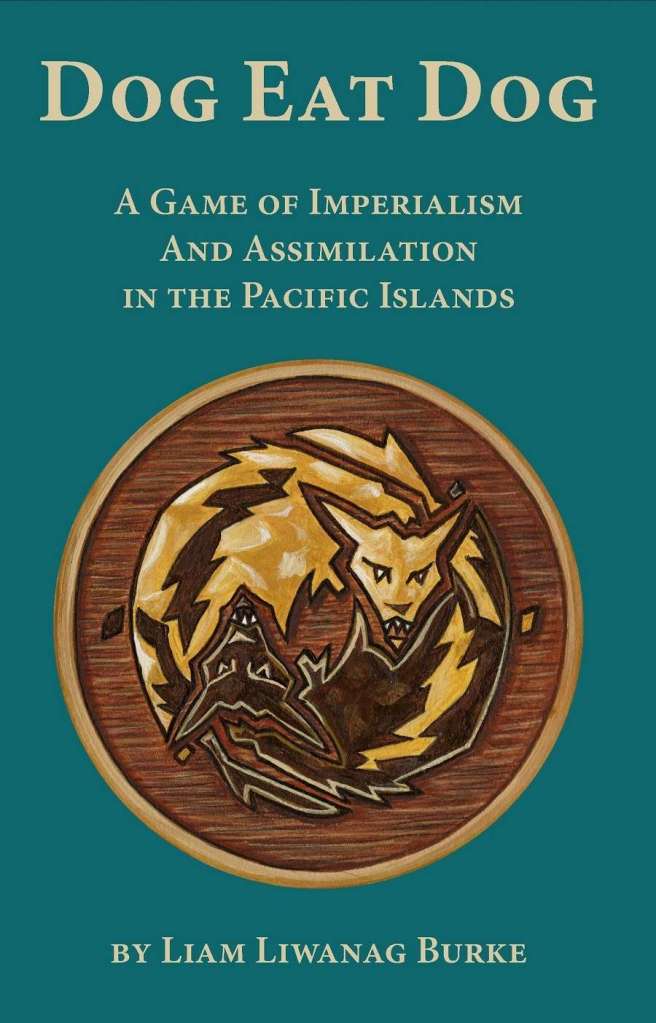
Liam Liwanag Burke’s Dog Eat Dog makes colonialism its explicit premise. One player is the Occupation, and each other plays a Native. The game begins just after a war of conquest, and the Natives must decide whether they’ll resist the Occupation or assimilate into it.
The Occupation (played by the “richest” player or the one who accumulated the most tokens in the previous game) starts with a distinct economic advantage (holding the most tokens). They can force their way into any scene and decide whether or not a Native enters a scene the Occupation is already in. They’re incentivized to insert themselves into scenes so they can pass judgment on the Natives according to progressively generated rules (the first of which is that the Natives are “inferior” to the Occupation) and even overturn dice rolls to arbitrarily decide conflicts’ outcomes. They can even choose to murder every other character in the very first scene, ensuring quick victory.
The only time the power balance tips in a Native’s favor is when they deplete their tokens and run Amok. They’re able to freely enter any scene, wreak havoc, decide the outcome of the conflict, and after that, they immediately die. It’s a quiet but obvious nod to Alexandre Kojève’s anthropological interpretation of Hegel’s master-slave dialectic: servitude exists in the space between the death struggle’s asymmetrical resolution and the transformation of the world through revolution.
Dog Eat Dog’s mechanics elegantly render the struggle between a colonial force and subjugated people using only some tokens, a few dice, and conversation. Like Paul Zimbardo’s Stanford Prison Experiment or Jane Elliott’s Blue Eyes / Brown Eyes exercise, it places ordinary people in a simulation of arbitrarily imbalanced power and privilege, illuminating invisible perspectives and socio-political positions. By experiencing them, we begin to discern the workings of injustice and, hopefully, points of intervention that can lead to change.
Dialect
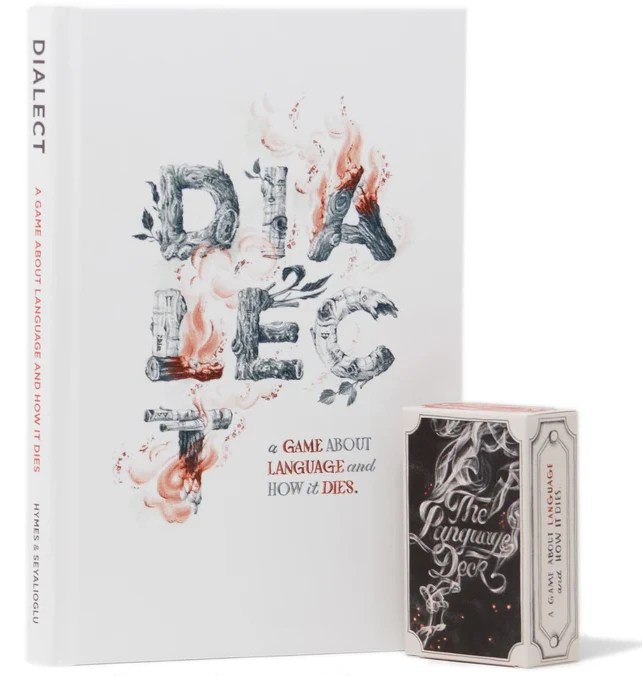
Kathryn Hymes and Hakan Seyalıoğlu’s Dialect is “a game about language and how it dies.” Players inhabit an isolated community, and over the course of the game, they invent new words (for which the book provides copious guidance and inspiration) and use them in scenes, crafting a dialect unique to the setting and the characters’ experiences. In the final phase, they will collectively narrate the community’s end and their dialect’s disappearance from history.
Indigenous languages across the globe currently face this threat of obliteration. “When that happens,” writes the Endangered Languages Project, “a unique vision of the world is lost. With every language that dies we lose an enormous cultural heritage; the understanding of how humans relate to the world around us; scientific, medical and botanical knowledge; and most importantly, we lose the expression of communities’ humor, love and life. In short, we lose the testimony of centuries of life.”
Dialect does not provide space for experimenting with solutions to protect and promote threatened languages. However, it does remind players that, after the game ends, “you are the sole speakers of your dialect now.” The simple statement emphasizes the urgency for conservation and prompts the postplay reflection that is so crucial for meaningful outcomes in future-oriented gaming.
Black Mass
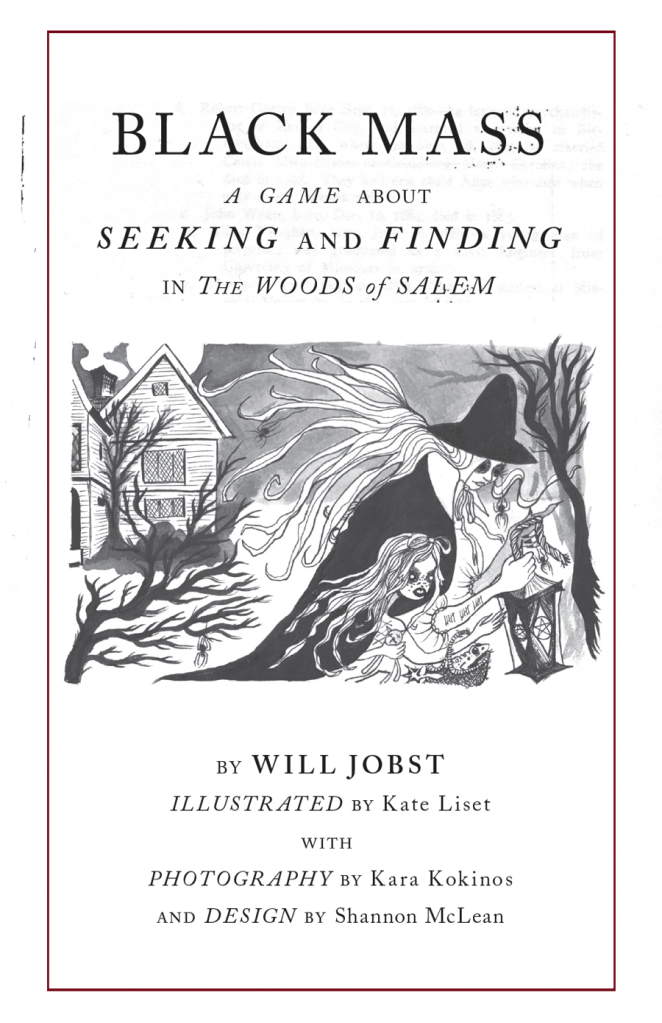
Will Jobst’s Black Mass takes players to 1690s Salem, Massachusetts. They’ll each control a persona of the two central characters, Catherine and Lydia, who have fled the settlement. The game has three modes of play (a spooky October, a realistic but eerie December, or a horror-steeped February), and players will develop the characters, their relationship, and their shared story based on prompts and actions determined by the mode, the personas, and draws from a tarot deck.
Black Mass sets its events against the historical witch-trial backdrop to subvert the contemporary narrative into a feminist reclamation of power. Via Catherine and Lydia, players will confront internalized demons of sexism and spiritual persecution on a journey of self-discovery and personal growth. What they find in the woods will change them, and they’ll return to Salem to retribute and reconstruct the society that has wronged them.
Dungeon Bitches

Like Dog Eat Dog, Emmy Allen’s Dungeon Bitches puts a subversive twist on adventure gaming’s traditional emphases and biases. The players all adopt queer female archetypes who are cast out of society; they exist at the fringes, finding community with one another as they mutually cope with trauma and navigate ever-present physical, emotional, and social violence.
Sarah Carapace’s artwork exquisitely captures the game’s themes. Her illustrations emphasize the body as an object of desire and as a thing made of meat and subjected to brutality. Everywhere, the feminine is juxtaposed with the monstrous and the horrific; the external, antagonistic gaze sees in them an identity, while the internal, sympathetic perspective places them in opposition while preserving a sense of kinship.
The eponymous bitches’ world is overtly allegorical for a toxic culture that enforces heteronormative and patriarchal ideologies. Queer, trans, and nonbinary bodies and desires threaten existing power structures through their rejection of conformity, and the status quo persecutes them by suppressing or trying to outright erase their existence. Dungeon Bitches is a space for exploring these identities, the threats against them, and their strategies for survival.
Applied Heuristics
These games, and others like them, all model specific problems. The more sophisticated a communication mode is, the more situation dependent it is. A simple communication like pointing will direct attention in almost any context, but as the old truism goes, “system matters,” and a specialized game is less likely to be applicable to a wide variety of problems. For a game to successfully convey a gestalt and cultivate a heuristic, it must closely define and accommodate the problem it wants to address.
But “it is during actual play that the ultimate success of the design can be perceived” (Gaming: The Future’s Language 50). Future-oriented games must respond to player input with realistic outcomes; if they do not model real dynamics, then the heuristics are useful only for gaming and not for living. This requires of designers and facilitators a deep, empirically grounded understanding of the issues at stake.
Duke concludes Gaming with a warning: “We must rely on the intelligent consensus of a broad citizen base if we are to sustain democracy” (172). RPGs’ appeal and capacity make them uniquely suited to pursuing this mission. Through them, we can identify impending dystopias and rip the veil from the ones we already live in.
This article was originally written on spec for Wyrd Science magazine.
The header is a mashup of images by giannsartori and Kelly. Both are open license.
Related posts

Ludo-Garbologies
4 games that make you think about trash

GAME OVER
How 4 TTRPGs imagine the end of the world
Imagining Dystopia
Neurocity & the cognitive, social, and political functions of RPGs
 Līber Lūdōrum
wonderful article thanks so much! We need more articles on the broader application of games to issues like colonialism.
LikeLike
Thank you for reading, and I’m glad you liked it! I agree–I’d love to see more games that are practical learning tools as much as they are entertainment.
LikeLike